



General Motors and Ford are both building affordable electric vehicles. Ford is developing its Universal EV (UEV) platform around a new midsize electric pickup, while GM is preparing its fourth-generation EV architecture with cheaper batteries, more efficient motors and AI-assisted development. Both companies are borrowing ideas already used by new-age EV makers such as Tesla and Rivian, but their approaches to battery development, vehicle design and manufacturing differ sharply.
Table of Contents
Ford Is Building An All-New EV Platform

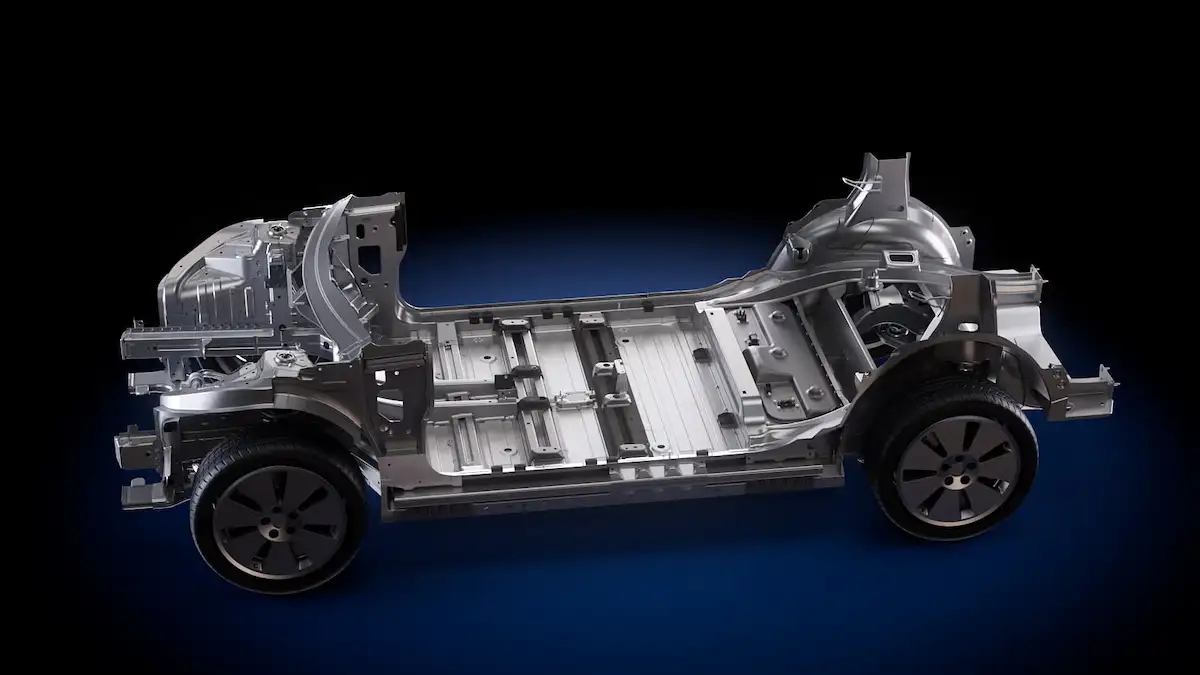
Ford’s upcoming electric midsize pickup, expected to arrive as a 2027 model, will be the first vehicle based on its new Universal EV (UEV) platform. The architecture is designed to support several future EVs, with Ford planning as many as five additional models. The company offered an early glimpse of some of these vehicles, hidden under covers, during a media tour of its Southern California development center in May. Camouflaged mules of the new electric pickup truck have also been caught testing in the US.
The UEV platform is built around a simpler vehicle architecture and a new manufacturing process intended to reduce production costs.
GM is pursuing similar goals with its fourth-generation EV platform. However, its strategy relies heavily on developing a new battery chemistry, making vehicles lighter and producing more efficient electric drive units. The company has not yet revealed the full lineup that will use the new architecture.
Both Companies Are Adopting Tesla-Style Technology
GM and Ford are moving toward software-defined vehicles, or SDVs. Instead of relying on dozens of separate processors from different suppliers, these use centralized computing to manage more of their functions through software.
This approach makes it easier to update vehicle software over the air, add features, improve performance and address certain problems without requiring a visit to a dealership.
GM says its new central computing unit will offer 40% faster processing than the current system. The company also plans to use this architecture in future high-volume gasoline vehicles, not just EVs.
Both automakers are also preparing to offer bidirectional charging. This allows an EV to send electricity back to the grid, and power a home or camp site. Owners can also use their vehicles to power household appliances and tools. These technologies are already familiar in parts of the EV industry, but GM and Ford want to bring them to more of their vehicles.
Different Approaches To Battery Selection
The biggest difference between the two strategies is battery development. GM is developing lithium manganese-rich (LMR) cells through its own battery research program. The company has invested $900 million in two facilities at its Warren Technical Center, where engineers can develop new cells, build small batches of prototypes and test them using low-volume production equipment.
LMR batteries are expected to offer a balance between energy density and cost. GM says they could deliver energy density close to existing nickel-manganese-cobalt-aluminum (NMCA) batteries while approaching the lower costs of lithium-iron-phosphate (LFP) cells.
Ford, meanwhile, is taking a different route for its UEV-based vehicles. It plans to manufacture low-cost LFP batteries at a new plant in Marshall, Michigan. Rather than developing the cell chemistry itself, Ford licensed the technology from CATL, China’s largest battery-cell manufacturer.
Both approaches aim to reduce EV prices, but in two very different ways. One invests in in-house development while the other relies on licensed technology.
Ford Is Starting With A Pickup. GM’s Lineup Is Less Clear.
Ford is launching its new EV platform with a midsize pickup, a segment where the company already has a strong presence. The Fathom is expected to join Ford’s F-Series, Ranger and Maverick, giving the automaker another electric offering in its truck lineup.
GM’s current electric pickups sit at the more expensive end of the market. Its Chevrolet and GMC electric trucks are full-size models weighing more than four tons and using large battery packs designed to deliver more than 300 miles of range. GM does not currently offer a compact pickup.
The company’s new EV platform is expected to support high-volume vehicles, including small and midsize SUVs. However, it remains unclear whether the same architecture can efficiently underpin everything from smaller crossovers to full-size trucks.
Zach Walker, GM’s director of global EV architecture, suggested that developing one platform to cover such a broad range of vehicle sizes would be extremely difficult. That leaves open the question of how far GM can stretch its new architecture and whether it will need separate platforms for different segments.
Ford Is Rethinking How Cars Are Built


Ford is also changing how its EVs are assembled. Its Louisville, Kentucky, plant has been extensively rebuilt to support a new production method for vehicles based on the UEV platform.
Instead of moving a vehicle through one continuous assembly line, Ford will build three major sections in parallel: the battery-and-powertrain platform, the front end and the rear section. These modules will then be joined near the end of the process.
Ford says this method requires fewer steps, speeds up assembly and lowers manufacturing costs. The company hopes the new process will help make its future EVs more affordable.
GM has shared fewer details about changes to its own assembly process. Walker said the shift toward software-defined vehicles will itself require changes to manufacturing.
Because the central computing unit and other electrical systems need to be installed early enough for teams to test them during assembly, GM will have to adjust the order in which vehicles are built. However, the company has not indicated that it plans to overhaul its entire production system in the same way Ford has.
Can GM Match Ford’s Cost-Cutting Approach?
GM and Ford are both trying to solve the same problem: how to build EVs that more people can afford without sacrificing useful range or performance.
Ford is combining low-cost LFP batteries with a dedicated platform and a redesigned assembly process. GM is focusing on its own LMR battery chemistry, more efficient motors, lighter vehicles and a simpler electronic architecture.
Neither strategy guarantees cheaper vehicles on its own. Battery costs, factory efficiency, development time and the ability to build vehicles at scale will all determine the final price. GM wants to bring EVs to mainstream buyers, much as Ford intends to do with its next-generation electric vehicles. The difference will come down to execution: which company can turn its new technology and manufacturing plans into affordable vehicles, and get them to customers sooner.
Add Vroom Head as a preferred source on Google News

