

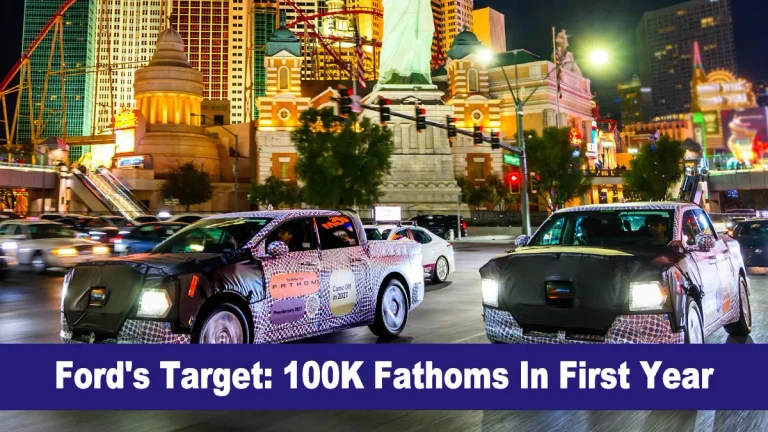
Ford is aiming high with the Fathom. According to a Wall Street Journal report, the automaker wants to sell more than 100,000 units of its upcoming affordable electric pickup in its first year. That makes the Fathom far more than another EV for Ford. The truck is central to the company’s plan to make electric vehicles cheaper to build and attractive to a much broader group of American buyers.
Table of Contents
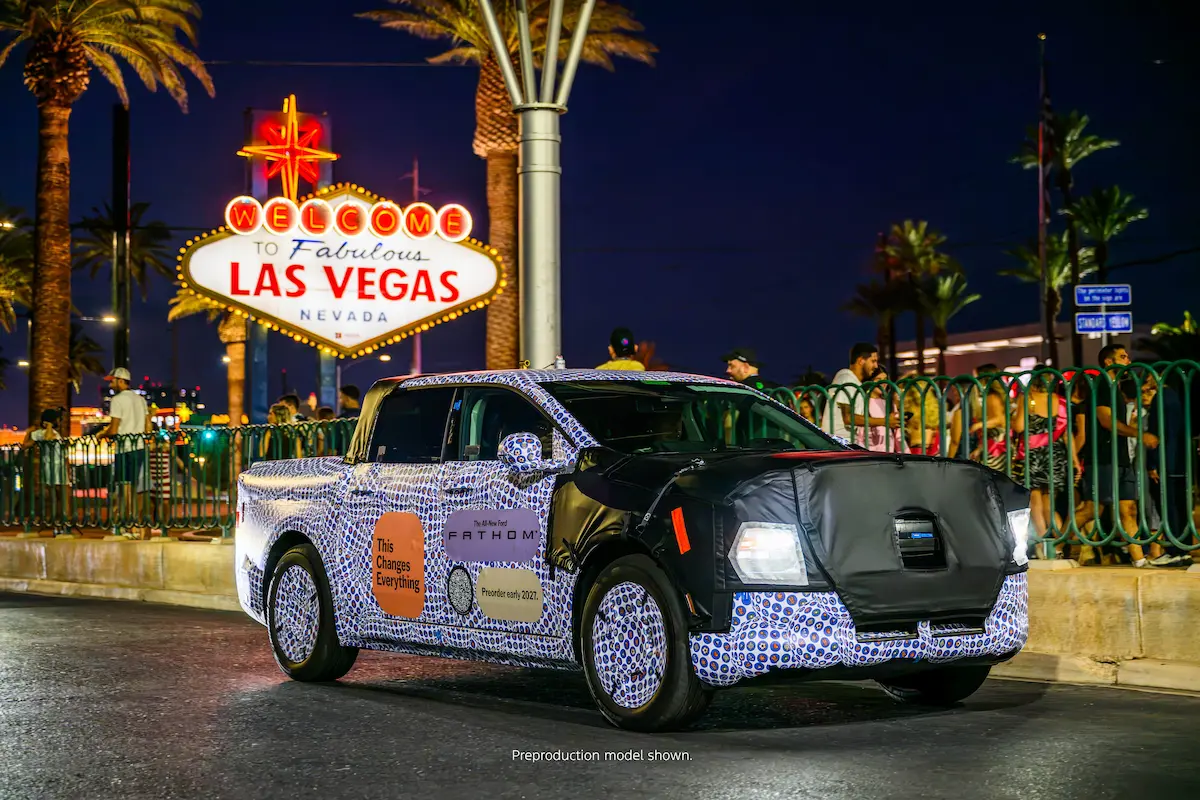
That ambitious target also helps explain Ford’s decision to put two heavily camouflaged Fathom prototypes on display in Las Vegas. The trucks were undergoing hot-weather testing when Ford took them onto the Strip, turning a development drive into an effective publicity event.
Ford Puts The Fathom In The Spotlight
Automakers normally try to keep future products away from cameras until they are ready for a full reveal. Ford appears to be taking a different approach with the Fathom.
The two prototypes were driven through Las Vegas as part of Ford’s broader hot-weather testing program. The Strip is among the busiest and most recognizable roads in the country, and its bright neon lighting made it impossible for the trucks to go unnoticed.
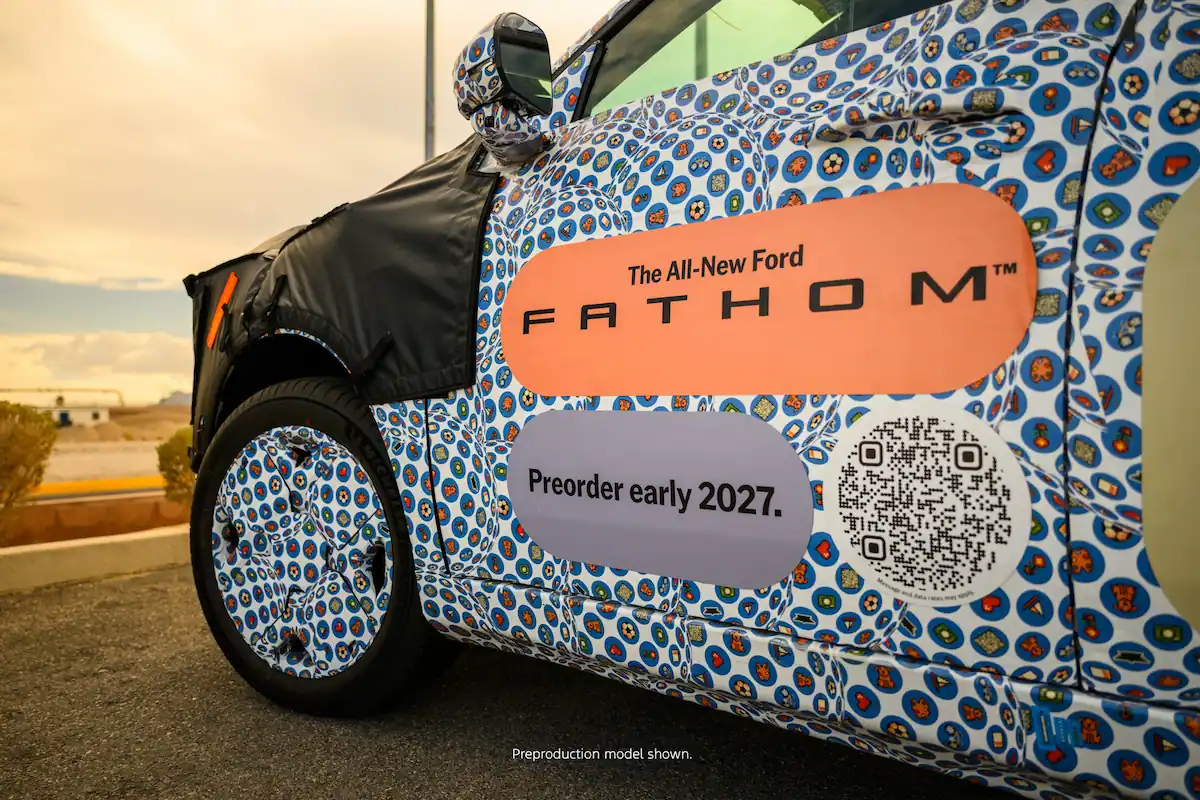
The Fathoms remained heavily disguised, with black-and-white camouflage covering most of the body and additional black material hiding much of the front end. Automakers sometimes use foam or other material beneath camouflage to alter the apparent shape of a prototype and make it harder to identify the production design.
Even so, these are the clearest official images Ford has released of the Fathom. Earlier footage showed very little of the truck, making the latest prototypes particularly useful for understanding what Ford is preparing.
Some Fathom Details Are Already Visible
The camouflage does not hide everything. The Fathom appears to have four conventional door handles, which could be a welcome choice for buyers who have grown tired of the complicated flush-mounted handles used on many modern EVs.
There are also openings in the front bumper that could indicate active aerodynamic hardware. The heavy front camouflage leaves room for forward-facing cameras and sensors, suggesting that Ford is integrating a substantial driver-assistance system.
The headlights have a traditional truck-like shape, while the tapered sides of the bed hint at additional cargo-storage features. Ford could be developing something similar to Ram’s available RamBox system, although the company has not confirmed that feature.
Another concealed element appears to be a factory tonneau cover. It is not yet clear whether Ford will use a roll-up system or another design.
A $30,000 Electric Pickup With Big Ambitions

The Fathom’s strongest selling point could be its price. Ford has announced a starting MSRP of $28,350, or $29,945 after the $1,595 destination charge.
That gives the Fathom a major advantage in a market where new vehicles and electric trucks have become increasingly expensive. Ford is also giving the pickup the practicality expected from a mainstream truck, including a bed, frunk and seating for five adults. The company says passenger volume will exceed that of the Toyota RAV4.
The Fathom will also feature a large high-resolution touchscreen, bidirectional power capability, a digital key and standard BlueCruise. Ford is integrating Apple Maps directly into the vehicle, making the Fathom the first Ford to offer that capability.
The official EPA range has not been released yet. Ford is expected to provide those numbers closer to launch.
The Fathom Is The First Step In A Bigger Plan
Ford’s ambitions extend well beyond one electric pickup. The Fathom is the first production vehicle based on the company’s Universal Electric Vehicle platform, or UEV, and several additional models are expected to follow.
The platform is built around a simpler manufacturing philosophy. Ford wants to reduce the number of parts used to build its EVs and simplify the assembly process, which should help lower costs and improve economies of scale.
That approach is critical because Ford’s earlier EV strategy proved expensive. The company has since shifted toward more affordable electric vehicles while continuing to invest in hybrids and gasoline-powered models.
The Fathom is therefore both a product and a test of Ford’s new EV strategy. If the truck can combine a low purchase price with efficient production and strong demand, the same architecture could support several future vehicles.
Ford Needs Volume To Make The Strategy Work
The scale of Ford’s reported sales goal shows what is at stake. More than 100,000 units would put the Fathom into serious mainstream territory from its first year and give Ford the production volume needed to make its new manufacturing strategy work.
For comparison, Ford sold 146,007 Broncos and 155,051 Mavericks in the U.S. last year. The entire F-Series lineup was much larger, reaching 828,832 sales, including 84,934 hybrid F-150s.
The challenge is that the Fathom will enter a U.S. market where EV demand has become more difficult to predict. Ford therefore needs the truck to appeal beyond traditional EV buyers. Its low price, familiar pickup proportions and practical features are designed to make that possible.
The Fathom Will Test Ford’s New EV Strategy
Ford plans to begin production in 2027, with preorders expected to open early that year. The truck will be built at Ford’s Louisville Assembly Plant in Kentucky as part of the company’s broader UEV manufacturing strategy.
The Fathom is being developed by Ford’s California-based EV team, which has been tasked with finding new ways to reduce the cost and complexity of building electric vehicles. Other UEV-based models are expected to follow.
That makes the Fathom more important than its camouflage-covered appearance might suggest. Ford is not simply trying to add another electric truck to its lineup. It is trying to prove that an affordable EV can sell at meaningful volume while also giving the company a more efficient way to build future electric vehicles.
The reported 100,000-unit target is certainly aggressive. But if Ford gets the price, practicality and manufacturing economics right, the Fathom could become the vehicle that determines whether its new affordable-EV strategy succeeds.


